
Post by Oliver Starr:
Are You Okay With Subsidizing the Slaughter of Wolves?
I've updated the post on my bounty for:
Post by Oliver Starr:
Trappers! Put Up or Shut Up!
Answer by Oliver Starr:
While there's been lots written about birds, chimps and cetaceans, my own vote goes to canids. Here's one example from NOVA and another from my own personal videos:
This dog knows over 1000 words!
http://youtu.be/_6479QAJuz8This wolf solves puzzles: (and steals my Apple hat as a reward) by the way, watch the little "butt hop" that keeps her tail from getting slammed in the door. In spite of never having done this before, she clearly understood the mechanics of the spring loaded closing mechanism. Smart!
http://youtu.be/xRzLIw3tHyo
Answer by Oliver Starr:
I'm not sure it's possible to answer this question with any degree of accuracy since we haven't even reliably identified all terrestrial vertebrates and have only limited knowledge of the numbers of many. There's even great controversy about how many wolves there are in just a few states, for example. Even though that number is a trivial component of total weight, every little bit adds up.
The one thing we can be sure of is that the ratio gets worse every year. Humans have virtually no selective pressure put upon them while wild animals have more every year.
Making matters worse, poaching, mining, deforestation, competition for range with domestic livestock and the ever increasing demand we humans have for land are all reducing the numbers and thus weight of the wild denizens of our planet.
It wouldn't surprise me at all if we were close to 99% vs 1%. This is a sad statistic considering that as recently as 700,000 years ago, humanity was nearly wiped out: Extinction Events That Almost Wiped Out Humans
Thus, in just a blink of the evolutionary eye, we went from an inconsequential component of the terrestrial vertebrate population to one that is not only dominant buy massively so.
Pearltrees is a place to collect, organize and share the things you care about. Please take a look at the resource I’ve curated here on wolves and if you share this interest, send me a team-up request and you can collaborate with me.
 A few of my thoughts on “sport hunting and trapping”:
Hunting of any kind is not a sport. Sport implies a competition between equally matched parties that are both aware of and agree to “the contest”. In sport, clear rules are established and known to all participants, and an impartial judge or referee is present to enforce the rules on both sides. In true sport any significant disadvantage by one side is generally offset by an equally significant handicap applied to the other side in order to maintain a fair level of competition. By no stretch of the imagination does hunting fall under this definition.
In fact, hunting is either an essential act required for survival (subsistence hunting), or it is a sadistic pass time practiced by serial killers of non-human species.

SSID_Messaging
If you want to know what’s going to happen next with a technology perhaps the smartest way to predict the future is to ask your kids – or someone else’s… It’s amazing what you might learn.
The other night, for example, I was having a meeting with Tom Foremski of Silicon Valley Watcher. His son, Matt, also happened to be present. I needed to log into their WiFi to go over a few things and as I did so I noted a number of funny networks in the area – phuckphace, for example.
When I mentioned this Matt told me how he and his friends are using the SSID – and it’s both clever and surprising: they use it to broadcast general messages to their local area. An example: someone’s SSID might be “shutyourdogup” (the intent being obvious). Another might be “partyatmyplacenexthurs”.
Sure, this is non-specific, but if you know who the network belongs to (or you know you’ve got a barking dog issue) this is a quick, dirty and free way to get the word to folks that are local to you.
Have you heard about another clever new way to use a technology you thought was fully exploited? Did you learn about it from someone half your age?
I’m curating a Pearltree on this topic, so please include links with your comments and I’ll add other cool tips to the Pearltree so that you can see what other folks have discovered.
 It’s easy to think of people from the underdeveloped world as quite different from ourselves. After all, there’s little to convince us otherwise. National Geographic Specials, video clips on the Nightly News, photos in every major newspaper – all depicting a culture and lifestyle that’s hard for us to imagine let alone relate to. Yes – they seem very different; or perhaps not. Consider this story related to me by a friend.
Ray was a pioneer in software. He sold his company some time ago for a considerable amount of money. After this – during his quasi-retirement he got involved in coordinating medical relief missions to some of the most impoverished places on the planet, places such as Timbuktu in Africa.
The missions were simple – come to a place like Timbuktu and set up medical clinics, provide basic medicines and health care training and generally try and improve the health prospects of native peoples wherever he went.
Upon arriving in Timbuktu, Ray observed that their system of commerce was incredibly simple. Basically they had two items that were in commerce – goats and charcoal.
According to Ray they had no established currency – they traded goats for charcoal, charcoal for goats or labor in exchange for either charcoal or goats. That was basically it.
Ray told me that after setting up the clinic and training people they also installed solar generators for the purpose of providing power for satellite phones that they left in several villages in the region.
They had anticipated that the natives, when faced with an emergency or if they needed additional medicines or supplies would use the satellite phones to communicate these needs however this isn’t what ended up happening…
Two years after his initial visit to Timbuktu, Ray went back to check on the clinics that they had set up and to make certain that the people there had the medicines and other supplies that they required.
Upon arriving at the same village he had visited before Ray was surprised to note that in the short period of only two years since his previous visit things had changed dramatically – things that had not changed for hundreds, perhaps even thousands of years.
Principally, the change was to the commerce in Timbuktu. No longer where goats and charcoal the principal unit of currency. They had been replaced by a single unified currency – satellite phone minutes!
Instead of using the satellite phones to call Ray’s organization, the natives of Timbuktu had figured out how to use the phones to call out to neighboring villages. This enabled more active commerce between the villages – the natives could now engage in trade miles from home – coordinating trade between villages, calling for labor when needed or exchanging excess charcoal for goats on a broader scale for example.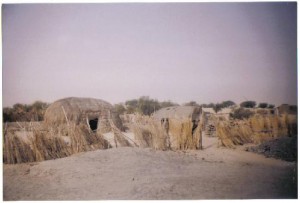
Of course their use of these phones wasn’t limited strictly to commerce – just like you and I, they also used these phones to find out what was happening in other places – who was getting married, who was sick or injured or simply to communicate with people from other places that were too far away to conveniently visit.
In other words, a civilization that had previously existed in a way that we would consider highly primitive had leapfrogged thousands of years of technological and cultural development and within the briefest of moments had adapted their lives to a technology that is among the most advanced of any broadly distributed in the modern world.
It’s a powerful reminder that in spite of our belief that primitive cultures are vastly different from us the truth is that basic human needs, when enabled by technology, are very much the same no matter where in the world or how advanced the civilization.
Perhaps we are not so different after all?